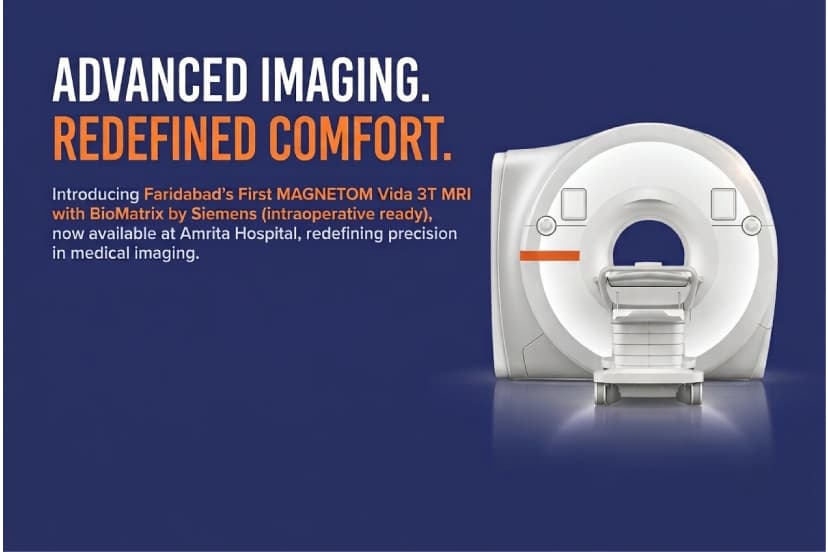
In a move that signals a shift towards more patient-friendly diagnostics, Amrita Hospital, Faridabad has introduced a next-generation MRI system—the MAGNETOM Vida 3T with BioMatrix technology—designed to make scans quicker, more comfortable, and significantly more reliable, especially for patients who traditionally struggle with MRI procedures.
For decades, MRI scans have required patients to remain completely still, follow breath-holding instructions, and endure long durations inside a confined space—factors that often lead to anxiety, discomfort, and in some cases, repeat scans. The newly installed system at Amrita Hospital aims to address these challenges by introducing a fundamentally different approach: one where the technology adapts to the patient, rather than the patient adjusting to the machine.
Dr. Sanjeev Singh, Medical Director, Amrita Hospital, Faridabad, explains, “What makes this MRI truly transformative is its ability to understand the patient in real time. It can automatically sense breathing and body movement and adjust the scan accordingly. This means we can achieve high-quality images even when patients are unable to hold their breath or remain perfectly still—something that was always a limitation with conventional MRI systems.”
This advancement is particularly significant for elderly patients, children, and those who are critically ill or in pain—groups for whom MRI scans can often be challenging. By reducing dependence on patient compliance, the system not only improves comfort but also enhances diagnostic accuracy.
Dr. Singh adds, “In many cases now, patients can breathe normally during the scan. That may sound simple, but clinically, it is a major leap. It allows us to include patients who were earlier difficult to scan and reduces the need for repeat imaging, saving valuable time in diagnosis and treatment.”
Beyond patient comfort, the system also brings considerable efficiency. Faster scan times and fewer repeat procedures mean quicker turnaround for results—an important factor in conditions where early diagnosis can significantly influence outcomes.
“With sharper imaging and more consistent results, we are able to detect conditions earlier and with greater confidence,” Dr. Singh notes. “Whether it is neurological disorders, cardiac conditions, or complex abdominal cases, the clarity of imaging directly impacts clinical decisions.” The design of the system also addresses one of the most common concerns associated with MRI—claustrophobia. With a wider bore and smoother patient handling, the experience is less intimidating, encouraging more patients to undergo timely diagnostic evaluation.
The introduction of this technology reflects Amrita Hospital’s continued focus on combining advanced medical innovation with patient-centric care. By making MRI scans more accessible, comfortable, and accurate, the hospital aims to improve not just diagnostic outcomes, but the overall patient experience.
Patients who have been advised MRI scans, or those experiencing symptoms requiring detailed imaging, can now access this advanced facility at Amrita Hospital, Faridabad through OPD consultations or direct appointments.