Nephrology
Overview
The Department of Nephrology at Amrita Hospital, Kochi provides comprehensive health care for patients with different types of renal (kidney) diseases. Acute and chronic renal diseases caused by diabetes mellitus, hypertension, stone disease, infections, hereditary illness and poisons are diagnosed and managed.
Doctors





Contact Us
Phone: 0484 - 6681327, 0484 - 2851327
Email: [email protected]
Specialities
- General Nephrology & Dialysis
- Transplantation & Transplant Immunology
- Pediatric Nephrology
- Onco-nephrology
Diseases Treated
- Diabetes,hypertension and kidney diseases.
- Cystic kidney disease.
- Kidney stones.
- Nephrotic syndrome.
- Glomerulonephritis (GN).
- Hemolytic uremic syndrome.
- SLE and Lupus Nephritis
- Renal Vasculitis
- End-stage renal (kidney) disease.
- Urinary tract infections (UTIs).
- Hyponatremia and other electrolyte disorders.
- Toxic overdoses that necessitate dialysis.
Features
- General Nephrology & Dialysis
- Renal Transplantation
- Pediatric Nephrology
- Transplantation & Transplant immunology
- Interventional Nephrology & Vascular access
- Critical care nephrology
- Community and preventive nephrology
Out Patient Services
Highly qualified and experienced physicians look after patients with various types of kidney diseases. The physicians are ably supported by a committed team of nurses, physician assistants, medical social workers and a renal nutritionist.
Why choose us?
- Expertise in treating renal problems in children and adults. Specialized services include a dialysis unit and a highly successful kidney transplantation program.
- Our goals are focused on optimal growth, good nutrition and quality of life for our patients.
- Our team includes nephrologists, residents, transplant and dialysis nurses, dietitians, and social workers.
- Our support and follow-up services include education and counseling for patients and their families.
What we offer
- Patient tailored individualized treatment.
- Economically effective and advanced treatment.
- Low-cost transplantation/ Subsidized transplantation.
- Advanced point of care.
- World class multi-organ transplantation.
- We perform high risk transplants.
Service
- General nephrology including renal biopsy
- Dedicated transplant unit with full immunological support
- Pediatric transplant
- Simultaneous multi organ transplantation
- ABO incompatible transplant
- Sensitized and high-risk transplant
- Deceased donor transplant
- Comprehensive dialysis care including dedicated vascular access clinic
- Hemodialysis, Peritoneal dialysis
- All types of dialysis vascular access and interventions
- Advanced therapies
- Hemodiafilteration, High flux dialysis
- Centrifugal plasmapheresis, Double filteration, Immunoadsorption
- Hemoperfusion for poisoning and sepsis
- Advanced transplant Services
- sPKtx (Nephro-GI)
- ABO iTx
- Composite tissue (PRS-Nephro)
- Tracheal transplant (PRS-Nephro)
- sHKTx (Nephro-Heart)
- Desensitization for highly-sensitized Stem cell transplant transplant (Hemat)
- Altruistic Tx services / Sensitized Tx services
- International patients Tx services
- Transplant
- Renal transplant without DJ stent
- Robotic renal transplant
- Treatment for Kidney Failure
- Patients with a severe degree of kidney failure cannot lead a comfortable life with medications and dietary restrictions alone. They need a treatment modality known as dialysis, a procedure to purify the blood by removing toxic substances.
- When a person has suffered an irreversible loss of more than 90% of kidney function, the patient is diagnosed as having end-stage renal disease and he has to undergo lifelong maintenance dialysis or a kidney transplant.
- The department offers two types of dialysis; hemodialysis, in which the patient’s blood is filtered by an artificial kidney and peritoneal dialysis, wherein a soft tube called a catheter is used to fill the abdomen with a cleansing liquid called dialysis solution.
- Those with end- stage renal disease are given the option of either hemodialysis or Continuous Ambulatory Peritoneal Dialysis (CAPD).
- Kidney Transplantation Services
- Patients who have end-stage renal disease have only two options available, kidney transplantation or life-long dialysis.
The Department of Nephrology coordinates the comprehensive kidney transplantation program. All essential departments and laboratory support are provided under one roof. A state-of-the-art hemodialysis unit prepares patients for the transplant surgery. The unit has the latest computerized dialysis machines and monitors to ensure patient safety. The most well-equipped and modern operation theatres provide a safe surgical procedure for patients where experienced and qualified anaesthesiology, urology and vascular surgery teams work together. - Well-planned protocol-based postoperative care helps in prompt recovery after surgery.
- Patients who have end-stage renal disease have only two options available, kidney transplantation or life-long dialysis.
Our Philosophy
We believe in delivering healthcare of the highest quality to every individual with compassion at its core. Our philosophy centers around achieving effective treatment solutions that are both economical and accessible, including subsidized outpatient hemodialysis and transplantation services. We are committed to offering world-class multi-organ transplantation and advanced extracorporeal therapies at nominal costs, ensuring comprehensive care for all patients. Additionally, we prioritize comprehensive training to equip our team with the skills necessary for performing high-risk procedures and advancing the field of nephrology.
Academy
- DM Nephrology
- B.Sc. in Dialysis Therapy
- M.Sc. in Dialysis Therapy
- B.Sc. in Physician Assistant
Facilities
- Dialysis unit
- Advanced extra corporeal therapies for auto-immune disease
- Advanced extra corporeal therapies for sepsis
- Transplantation across blood group barrier renal transplantation
- Multi-organ and composite tissue transplantation immunological support
- Advanced extracorporeal therapies for advanced liver failure
- Dedicated vascular access clinic
- Hemodialysis Unit
In this state-of-the-art facility patients are continuously monitored by modern electronic devices to provide smooth and comfortable treatment with a greatly reduced risk of complications.
The dialysis therapists work closely with the nephrologists, the trained staff nurses, and medical social workers to provide comprehensive care. There are also facilities for plasmapheresis, which is a procedure to remove toxins and unwanted proteins from the blood of patients who have auto-immune diseases. - Diagnostic Facilities
The well-equipped clinical laboratories and imaging services offer the necessary facilities for investigating patients with kidney diseases. A powerful MRI, high-speed Spiral CT Scanner, and Gamma Camera provide clear images and functional renal evaluation.
Kidney biopsy is a diagnostic procedure used to diagnose different types of kidney diseases. Ultrasonogram guided spring-loaded thin needle kidney biopsy reduces the complications of the procedure considerably.
FAQs
When blood pressure is too high, it can harm the tiny blood vessels in the kidneys, which are responsible for filtering waste from the blood. This damage can make it difficult for the kidneys to clean the blood properly.
Chronic kidney disease is categorized into stages based on a blood test called glomerular filtration rate (GFR), which indicates kidney function. The stages range from mild kidney damage with normal function to severe kidney failure.
Dialysis is usually necessary when kidney function declines to less than 10-15ml/min and symptoms like shortness of breath, confusion, and nausea occur.
Hemodialysis uses a machine to filter blood outside the body, while peritoneal dialysis cleans blood inside the body using a catheter in the abdomen.
Kidney stones form from deposits of calcium and/or uric acid in the kidneys. Some individuals are more prone to developing kidney stones and may benefit from a metabolic evaluation to determine the underlying causes.
Patients with severe kidney failure often require more than medications and dietary changes. They may need dialysis, a procedure that cleanses the blood by removing toxins. If kidney function drops below 10%, a patient may need lifelong dialysis or a kidney transplant.
The department offers two main types of dialysis: hemodialysis and peritoneal dialysis. Hemodialysis uses a machine to filter blood, while peritoneal dialysis involves using a catheter to fill the abdomen with a cleansing solution. Patients with end-stage renal disease can choose between hemodialysis and Continuous Ambulatory Peritoneal Dialysis (CAPD).
Patients with end-stage renal disease have two main options: kidney transplantation or lifelong dialysis. The department coordinates a comprehensive kidney transplantation program, providing state-of-the-art facilities and postoperative care to ensure patient safety and prompt recovery.
The hemodialysis unit utilizes modern electronic devices to monitor patients continuously, reducing the risk of complications. Dialysis therapists, nephrologists, nurses, and social workers work together to provide comprehensive care, including plasmapheresis for patients with autoimmune diseases.
The department's clinical laboratories and imaging services offer advanced diagnostic tools, including MRI, CT scans, and kidney biopsies. Ultrasonogram-guided kidney biopsies are performed with thin needles, minimizing complications and providing accurate diagnosis for different types of kidney diseases.
Diagnostic Tests and Procedures
1.Serum Creatinine :
- Measures the levels of creatinine in the blood, indicating kidney function.
- Elevated levels may suggest progressive kidney disease.
2.Glomerular Filtration Rate (GFR) :
- Assesses how effectively the kidneys filter waste from the blood.
- Declining values may indicate kidney dysfunction or failure.
3.Blood Urea Nitrogen (BUN) :
- Measures the amount of urea nitrogen in the blood, reflecting kidney function.
- Elevated levels may indicate decreased kidney function.
1.Urinalysis :
- Examines urine for abnormalities using a microscope or dipstick test.
- Detects protein, blood, bacteria, sugar, or pus, indicating various kidney and urinary tract conditions.
2.24-Hour Urine Test :
- Collects urine over 24 hours to assess kidney's ability to produce urine and leakage of protein and electrolytes.
3.Creatinine Clearance :
- Compares creatinine levels in urine and blood to determine kidney's waste filtration rate.
4.Microalbuminuria :
- Sensitive dipstick test detecting small amounts of albumin in urine, crucial for individuals at risk of kidney conditions.
1.Ultrasound :
- Uses sound waves to create images of the kidneys, identifying changes in size, position, or obstructions.
2.CT Scan :
- Utilizes X-rays to create detailed kidney images, detecting structural abnormalities or obstructions.
3.Biopsy :
- Involves taking tiny kidney tissue samples for examination, aiding in diagnosis, treatment planning, and transplant assessment.
4.Hemodialysis :
- Cleanses blood outside the body using an artificial kidney machine, vital for end-stage kidney failure.
5.Kidney Transplant :
- Surgical procedure replacing a damaged kidney with a matching donor organ, offering a long-term solution for kidney failure.
Outreach Program
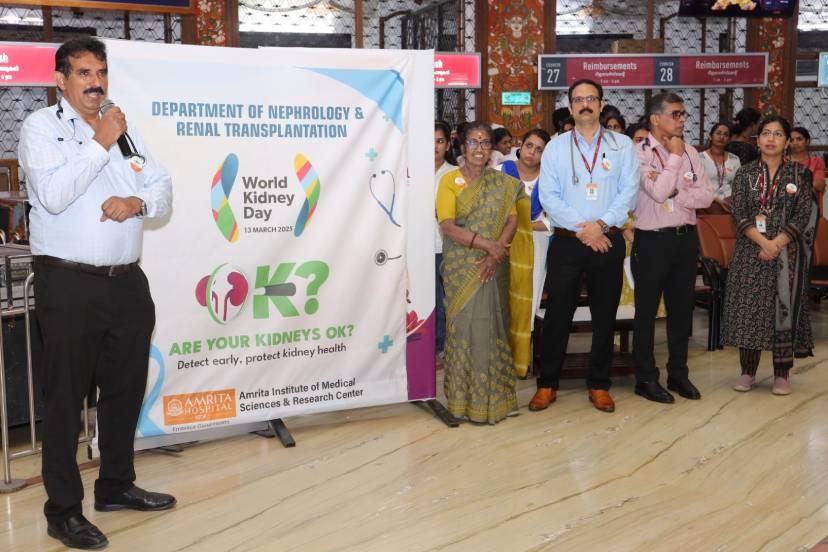
- Camps on world kidney day (2014 to 2019)
- Camps associated with organizations
- Baithulmaal charitable trust
- Melam Charitable organization
- Amrita Hospitals
- Nephrology association of Kerala
- Cochin Kidney club
International Collaborations
- International collaboration with NHS Coventry, UK for 1yr fellowship in transplant
- Team of Nephrologists from Army Hospital Bangladesh attended a training for kidney Transplantation in July 2017
- Pan African E Health programme 2015 - one of six centres selected by the Ministry of External Affairs, Govt of India
Featured News