Unable to breathe normally and forced to depend on a tube inserted through his neck, the Indore patient underwent a highly complex windpipe reconstruction at Amrita Hospital; a year later, doctors say his airway is now normal
A freak workplace accident that took only seconds left an Indore man with a crushed windpipe, nearly 99% blockage of his natural airway and dependence on a tube inserted through his neck just to stay alive.
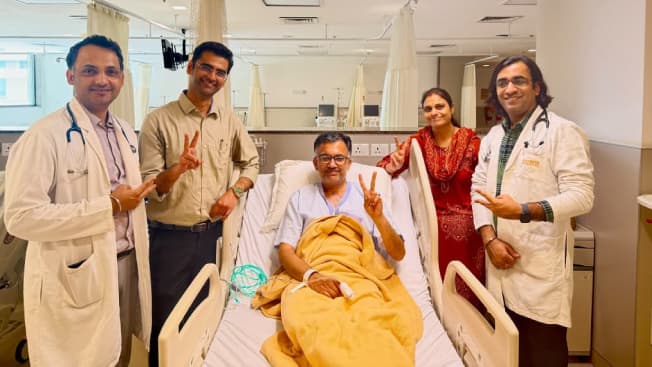
A year later, after a technically demanding airway reconstruction and repeated bronchoscopic interventions at Amrita Hospital, Faridabad, the patient is breathing normally again, speaking through his natural airway and returning to everyday life.
The patient, Sunil Kumar from Indore, suffered the devastating neck injury after a piece of cloth became caught in a machine. The force of the accident severely injured and fractured the airway. As the damaged area narrowed, almost the entire breathing passage below his voice box became blocked.
Doctors treating him initially performed an emergency tracheostomy, creating an opening in his neck and inserting a breathing tube below the obstruction. The procedure saved his life, but it also meant that Sunil could breathe only through the tube and could not speak normally through his mouth.
He was subsequently referred from Indore to Amrita Hospital, Faridabad, because definitive reconstruction of the severely damaged windpipe required specialised airway surgery.
At Amrita, investigations including CT scans and bronchoscopy revealed the full extent of the damage. The airway was critically narrowed immediately below the voice box, at the beginning of the windpipe. Adding to the complexity, one of the nerves involved in voice function had also been damaged during the accident.
According to Dr. Shikhar Sawhney, Head & Neck Surgery, Amrita Hospital, Faridabad, the only definitive option was to remove the severely damaged segment of the windpipe and reconnect the healthy portions. “This was not a routine airway operation. Nearly 99% of his natural airway was closed and the injury was very close to the voice box. Unlike many other organs, we have only one trachea, so there is very little room for error. The damaged segment had to be carefully removed and the healthy ends reconstructed while protecting the structures responsible for breathing and voice,” said Dr. Sawhney.
The surgery itself was only one part of Sunil’s recovery.
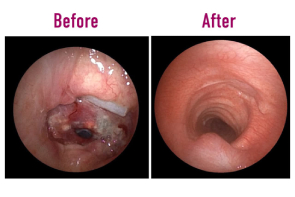
As the reconstructed windpipe began healing, scar tissue caused fresh narrowing at the operated site — a recognised challenge following major airway reconstruction. This required close cooperation with the Interventional Pulmonology team, which used bronchoscopy to repeatedly assess the inside of the airway and dilate the narrowed segment when required.
Dr. Sourabh Pahuja, Interventional Pulmonology, Amrita Hospital, Faridabad, said that long-term surveillance was crucial in preventing the airway from narrowing again. “In these patients, completing the surgery does not necessarily mean the treatment is over. Healing itself can produce scar tissue, which can again obstruct the airway. Bronchoscopy allows us to see the reconstructed portion directly and intervene before the narrowing becomes severe. In Sunil’s case, continued bronchoscopic assessment and airway dilation played an important role in achieving the final result,” said Dr. Pahuja.
The latest bronchoscopy, performed approximately a year after treatment, brought the result doctors and the patient had been working towards.
The reconstructed airway was found to be well healed and essentially normal.
Sunil is now able to breathe through his natural airway, speak normally and lead his life without dependence on the tracheostomy tube.
The case is particularly significant because severe traumatic injuries to the windpipe are uncommon but can rapidly become fatal if the airway is compromised. Even when emergency tracheostomy saves the patient, restoring a functional natural airway can require highly specialised surgery, interventional pulmonology and prolonged follow-up.
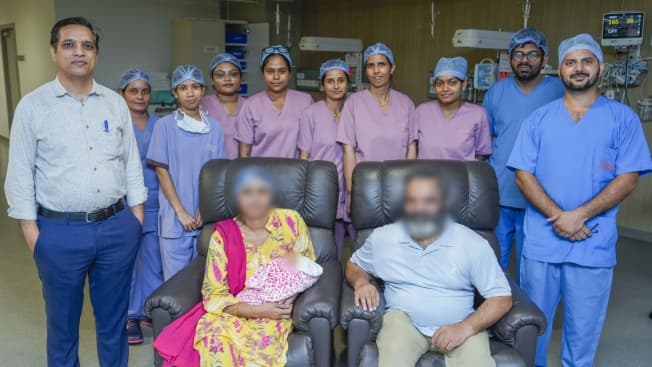
For Sunil, what began as an accident that almost completely shut his airway ultimately required a multidisciplinary effort involving Head & Neck Surgery and Interventional Pulmonology.
From breathing through a tube in his neck to breathing and speaking normally again, his recovery underscores how coordinated airway reconstruction and bronchoscopic care can change the outcome even in an exceptionally difficult tracheal injury.