Head and Neck Surgery
Overview
The Head and Neck Oncology Service at Amrita Hospital, Faridabad, has continuously aimed to be a leading voice in full multidisciplinary care. The equipment, clinical services provided, and patient care outcomes are comparable to those of the world's top hospitals. Tumors of the mouth, throat, voice box (larynx), and the accompanying tissues such sinuses, salivary glands, and thyroid gland make up head and neck cancers.
Facilities Available
1. Oral Cavity Cancers
- Cancer ablative surgeries for Tumors involving the Tongue, Gingivo-Buccal regions, Palate and lower jaw bone
- State-of-the- art Reconstruction services at the same time to bring the patient back to normal/near normal condition. (Both functionally & aesthetically)
2. Oropharyngeal Tumors
- All types of minor biopsy procedures to diagnose the cancers
- Cancer ablative surgeries including Minimally invasive surgeries i.e., Trans-Oral Robotic Surgery (TORS) & Trans-Oral Laser Surgery (TOLS) and Open approach surgeries
- Scarless surgery – TORS/TOLS
3. Laryngeal & Hypopharyngeal Tumors
- Diagnostic and Therapeutic Fiber-optic Endoscopic services
- Direct Laryngoscopy and Biopsy
- Minimal Invasive Surgeries i.e., Trans-Oral Laser Surgery with CO2 Laser
- Voice preserving / Conservative Partial laryngectomies/pharyngectomy
- Major Cancer ablative surgeries including Total Laryngectomy, Laryngo-pharyngectomy and Laryngo-Pharyngo-Esophagectomy
- Voice rehabilitation with Electrolarynx, Esophageal speech and Tracheostomy-Esophageal prosthesis (TEP)
- Cervical esophageal stricture repair in post corrosive injury cases
4. Sino-Nasal & Skull Base Tumors
- Endoscopic diagnostic & therapeutic procedures
- Endoscopic approach Tumor removal i.e., Endoscopic Cranio-Facial resection & Endoscopic Maxillectomy/Ethmoidectomy
- Navigation assisted surgeries combined with expertise of neurosurgeons
- Open Maxillectomy, Orbit Exenteration, Open Craniotomy-Facial resection, All types of temporal bone resection with facial reanimation procedures and Open skull base surgeries
5. Thyroid and Parathyroid Tumors
- Minimal Invasive surgeries i.e., Keyhole surgery, Endoscopic Surgery
- Robotic Thyroidectomy
- Suture less (Harmonic Scalpel) Thyroidectomy
- Complex Open Thyroidectomy including the tracheal/ Laryngeal/ esophageal resection with reconstruction
5. Tracheal Tumors
- Endoscopic/open surgeries for Tracheal tumors
- Tracheal resection and repair
6. Salivary Gland Tumors
- All types of Parotidectomies i.e., Adequate, Superficial, Total & Radical
- Sub-mandibular gland tumor surgeries
- Minor salivary gland tumor removal surgery
- Management of Salivary fistulas
- Facial re-animation surgeries for Facial palsy with Free Functional muscle transfer, temporalis tendon transfer, gold weight implant etc.
7. Skin / Scalp Tumors
- Mohs micrographic surgery for skin cancers
- Scalp Tumor surgery and reconstruction
8. Vascular Tumors in Head and Neck
- Surgery for Lymphangiomas
- Surgery for Carotid body tumors
- Surgery for Vascular malformations (Low flow to high flow lesions)
- Surgery for JNA (Juvenile Nasopharyngeal Angiofibroma)
9. Parapharyngeal Space Tumors
- Trans-oral / Trans-cervical approach for tumors excision
- Trans-Mandibular / Trans-Parotid approach for Tumor excision
10. Secondary Defects Reconstruction
- Functional and aesthetic reconstruction of post cancer ablative surgery or post mucomycosis debridement defects or post-traumatic defects of upper jaw / lower jaw
11.Benign Conditions
- Thyroglossal cyst or Fistula surgery
- Lingual thyroid excision
- Laryngocele excision
- Ameloblastoma excision and reconstruction
- Branchial cyst or sinus excision
- Tracheal stenosis or esophageal stricture repair
- Laser Kashima procedure for vocal cord palsy
12. Minimally Invasive Surgeries
- Keyhole surgery
- Trans-oral laser surgeries
- Trans-Oral Robotic surgeries (TORS)
- Robotic Thyroidectomy
- Suture less thyroid surgery (Harmonic scalpel surgery)
- Endoscopic Skull base and sinus tumor removal surgery
13. Other Services
- Virtual surgical planning with VRT Model and 3D printing Software
- Patient specific implants / Hardware for reconstruction of maxilla (Upper jaw), mandible (Lower jaw) and orbit defects
- Dental rehabilitation in the form of dentures and implants
- Prosthetic implants for defects of face, ear and eye socket
- Dental oncology for pre- and post-radiotherapy care for head and neck cancer patients.
14.Swallowing Disorders Unit / Deglutology Unit
Swallowing/Deglutition is a complex physiological process, and several conditions can interfere with this process. Dysphagia and swallowing problems are common and can occur in any age group interfering with routines of eating and drinking that can normally be taken for granted. There are many causes: Head and Neck Cancers, Neurological (CVA, Neurodegenerative Disorders), Structural damages are some of common causes of swallowing disorders (Dysphagia). Patients are referred to the Swallowing Disorders Unit/ Dysphagia Unit/ Deglutology Unit to undergo assessment of their swallowing function for identification, management and treatment of Dysphagia. Imaging methods such as Videofluoroscopic Swallow Study (VFSS) and Endoscopic examination (Flexible Endoscopic Evaluation of Swallowing- FEES) could also be undertaken if indicated.
Management of the swallowing disorder is done through counselling the patient and caregivers of specific swallowing techniques/ strategies/ dietary modifications to follow while feeding and surgical intervention if necessary.
Significance of Swallowing Disorders Unit/ Dysphagia Unit/ Deglutology Unit:
- Research shows that about 5% of general population have dysphagia.
- One in two head and neck cancer patients suffer from swallowing disorders, while 80% of adults with Motor neuron disease and children with cerebral palsy and Down syndrome suffer from the same.
- Adults with Dementia (13 to 57%), Parkinson’s disease (35 to 80%), Mental illness (32%) and prolonged medical care due to old age (30%) also suffer from dysphagia in a large extent.
- Swallowing difficulties impact normal life drastically not only for the patient but even their care givers. It often leads to malnutrition, dehydration and recurrent chest infections. Mortality rates are also significantly high among these patients. Sometimes, patients have recurrent hospital admission and prolonged hospital stays leading to repeated courses of antibiotics and dependence on feeding tubes, which in turn, increase the financial burden of the families. Notwithstanding its incidence and the influence, it has on so many aspects of daily life as well as on health and wellbeing, swallowing disorders remains undetected and untreated in many medical institutions and residential care home, globally.
Services Offered
What We Provide:
- The Swallowing Disorders Unit/ Dysphagia Unit/ Deglutology Unit at Amrita Hospital, Faridabad, provides specialist expertise in the assessment and management of complex feeding and swallowing problems.
- Clinical and imaging examinations are done when indicated, the results are then discussed with the family caring for the patient. Further detailed assessments, recommendations, or methods/ strategies/ techniques of feeding to be followed are conveyed.
- After head and neck cancer treatment, sufficient rehabilitation of the patient with respect to swallowing function is required.
- A dedicated Swallowing Disorders Unit/ Dysphagia Unit/ Deglutology Unit which participates in the early rehabilitation of swallowing function of these patients is needed to improve their quality of life and cure. These patients include both, those who have undergone surgery and those who have received radiation and chemotherapy treatment.
- The dedicated Swallowing Disorders Unit/ Dysphagia Unit/ Deglutology Unit also participates in the assessment, management, treatment and rehabilitation of swallowing function of patients with post stroke dysphagia, post neurosurgery dysphagia, dysphagia in neurodegenerative disorders etc.
- Endoscopic (FEES) and Videofluoroscopic Swallow Study (VFSS) evaluation precisely identifies the problem in these patients which can be corrected by rehabilitative techniques/ Surgical interventions if indicated.
- Infants, children and adults who have some degree of neurological impairment, resulting in severe and specific difficulties while eating and drinking can avail this service.
Team Approach
- Swallowing disorders have differing etiologies and involve many systems of the body.
- The swallowing service team comprises of a consultant Deglutologist/ Swallowing Pathologist specializing in Swallowing Disorders, Head & Neck Oncosurgeon, Otolaryngologist, Pediatric Neurologist, Psychiatrist, Gastrosurgeon, Medical Oncologist, Radiation Oncologist, Surgical Oncologist, Gastroenterologist, Stroke Medicine Physician, Neurosurgeon and Neurologist.
- These diverse specialists come together to provide cutting edge advances and diagnosis to patients.
- This helps to provide comprehensive treatment and care to the patient.
- The multidisciplinary approach to treat Dysphagia as more than just an assessment and management strategy using Videofluoroscopy, FEES, Manometry and Electromyography to a more comprehensive approach by understanding brainstem control mechanism, cortical modulatory effects on deglutition and effects of phagosurgery.
Why Amrita Hospital Faridabad?
- Multi-Department Tumor board discussions
- Top class surgeons in the field of Head and Neck cancers management
- “One center for all” – Starting from prevention to cure with all sort of investigations and treatment with affordable cost
- Provides “Compassionate Care”
- 24-hour availability of micro-vascular surgeons, expert airway intensivist and anesthetists
- Dedicated Swallowing and speech service for early rehabilitation of cancer patients
Patient Stories
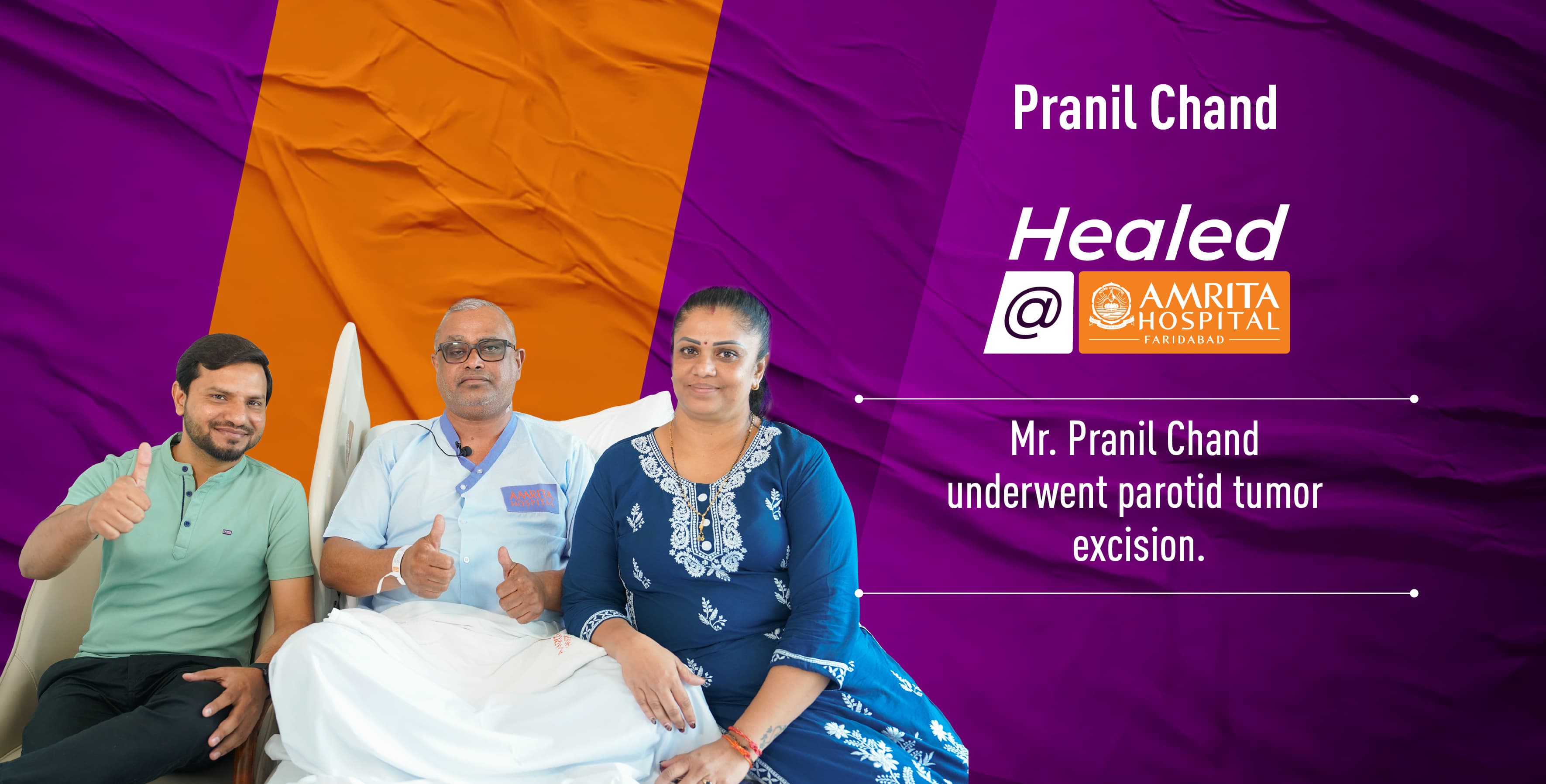
Fiji patient underwent parotid tumor excision
Pramil Chand hailing, Fiji
Doctors